

Build AI that delivers in production.
At QCon San Francisco 2026, discover how senior engineering teams are making AI reliable, scalable, and cost-efficient, turning prototypes into systems that drive measurable business impact.
November 16–20, 2026
Hyatt Regency, San Francisco
Early Bird Deadline November 10th
Conference: $2,995
Secure early bird savings - deadline coming soon!
Need to convince your manager, or team?
Use our templates.
AI & ML sessions at QCon San Francisco 2026
Nov 16
How Airbnb Guardrailed Its AI Customer Support Agent
When Airbnb launched its AI customer support assistant, the feature made the news — the guardrails built to make it safe to ship did not. Yet an AI agent that talks to millions of customers, remembers a conversation across turns, and can trigger account actions is a

Weiping Peng
Distinguished Engineer @Airbnb, Previously Principal Architect @Salesforce for AI platform
Nov 16
Adapt or Drift: Resilience Engineering When AI Moves the Operating Point
Resilient systems do not stay resilient by standing still. They survive by adapting. But adaptation comes with risk: under sustained pressure, organizations and systems can slowly drift toward failure while still appearing to operate normally.

Andrew Hatch
Engineering Leader and SRE Manager @Cisco ThousandEyes, With 25+ Years Building Software, Operations, SRE, and Platform Teams Across Australia, India, and the United States
Nov 16
LLM Flip-Flops: From Reliability Risk to a Hill-Climbing Signal
Run the same task through the same LLM twice, and you may get two materially different answers. This behavior is often dismissed as the stochastic nature of LLMs, but it creates a serious product risk.

Diane Lin
Staff Engineer @Datadog
Nov 16
The Schema Was Never Enough: The World in Protocols
Every reliable process in the world is a protocol: auctions, double-entry bookkeeping, brokerage account transfers, or APIs. Protocols reduce ambiguity but the world remains messy.

Ryan Brown
Building infrastructure @Render, Previously Principal @Crunchyroll, @Red Hat, and @Vendia
Nov 16
How to Build a Real-Time Voice Agent
A voice agent looks like a chatbot with a microphone.

Rishabh Bhargava
Director of ML @Together AI
Nov 16
No New Backend: The API Layer Behind 800+ Agent-Built Apps at Duolingo
At Duolingo, anyone (engineer or not) can describe an internal tool and get a working app back, deployed against real company systems. That's BuildingHub, and 350 Duolingo employees have created at least one app with it.

Sarah Deitke
Senior Software Engineer @Duolingo
Nov 16
Generation Got Cheap, Trust Didn’t: Scaling Agentic Changes from Prompt to Prod at Roblox
As AI agents write more of the code Roblox engineers push, the hard part is no longer generating changes; it’s knowing which ones to trust.

Kushan Mehta
Principal Software Engineer @Roblox, Tech Lead for AI-Native Engineering

Jay Moorthi
Senior Engineering Manager, Diagnostics @Roblox
Nov 16
Agentic Trust: Securing AI Agents in Production
This session will cover practical measures that you can take now to run agents more securely in production. This will not cover topics like model training and alignment; rather it will focus on deploying an existing agent as safely as possible.

Amanda Walker
Sr. Director, Engineering - Privacy, Safety and Security @Google
Nov 16
It's Never the Thing That Broke: Learning From Incidents at (AI) Speed
When something breaks, our first instinct is to focus on the thing that failed. But in complex systems, the failure is usually the result of many things going right, changing, and interacting in ways we didn't anticipate.

Vanessa Huerta Granda
Resilience Engineering Manager @Enova, Co-Author of the Howie Guide on Post Incident Analysis, Board Member for the Resilience in Software Foundation
Nov 17
Skills, Memory, or Fine-Tuning? The Engineering Loop Behind Production Agents
After deploying and improving hundreds of production agents, each handling millions of requests, we've seen the same patterns emerge in what works (and what doesn't) when trying to make agents better.

Abhinav Sinha
CEO @Lucidic AI, Previously @Stanford AI Lab, @Citadel and Susquehanna International Group, and @Apple
Nov 17
Inside Asimov: BlackRock’s Platform Architecture for Applied AI at Scale
BlackRock’s Portfolio Management Group is transforming how investment teams conduct research by combining deep investment expertise with shared AI capabilities.

Dan Wolf
Head of Platform Engineering for PMG Tech @BlackRock

Sri Annapurna Bhupatiraju
Director and Principal Engineer @BlackRock, One of the Founding Members of BlackRock AI Labs
Nov 17
Use AI to Multiply Your Team as a Staff Engineer
Most "AI for engineers" content is about typing faster. That's IC-level work. Staff engineers have a different question to answer. When AI raises the floor on what every engineer can ship, what is the staff engineer's job, and where does the leverage actually come from now?

Jordan Cutler
Senior Staff Engineer and Web Tech Lead @Pinterest, Author of High Growth Engineer Newsletter
Nov 17
Building a Data Platform with AI
Data platform sits at the intersection of infrastructure, governance, operations, and user experience.

Mouli Mukherjee
Engineering Manager @OpenAI
Nov 17
The Revenge of the Data Scientist: Why Reliable AI Needs Evals, Traces, and Metrics
Most teams can now ship an AI prototype by calling a foundation-model API. The hard part is knowing whether that system works when real users, messy data, and business consequences arrive.

Hamel Husain
Machine Learning Engineer, 20+ Years in Applied AI, Machine Learning, and Data Science
Nov 17
Lessons from Building a $100M Product in Six Weeks at OpenAI
Engineering is shifting from synchronous, line-by-line implementation to an asynchronous model in which agents execute, verify, and retry while humans own intent, architecture, constraints, and release decisions.

Brian Yang
Member of Technical Staff @OpenAI
Nov 17
When Your Users Are Agents: Lessons from a Distributed Postgres Platform
Distributed systems are built around assumptions about workload behavior: connections have reasonable lifetimes, retries eventually stop, traffic spikes have recognizable causes, and application code produces somewhat predictable query patterns.

Gwen Shapira
Co-Founder and CPO @Nile, Previously Engineering Leader @Confluent, PMC Member @Kafka, & Committer Apache Sqoop
Nov 17
Bridging Retrieval and Ranking: From LLM Embeddings and Graph Features to a GPU-Served DLRM
The LinkedIn Feed retrieval layer selects, within 120 ms, the handful of posts each member sees from hundreds of millions of candidates. This split-second decision shapes what over a billion professionals read and engage with every day.

Sudarshan Srinivasa Ramanujam
Lead Engineer @LinkedIn - Working on Feed Ranking & Retrieval Modeling
Nov 17
Failing in Layers: Lessons from Rebuilding Netflix's ML Serving Platform
Everyone talks about model quality. Fewer people talk about what happens when that model has to serve real traffic without falling over, or why the system ended up shaped the way it did in the first place.

Rajat Shah
Staff Software Engineer @Netflix

Wenbing Bai
Senior Software Engineer, AI Platform Team @Netflix
Nov 17
Adaptive Systems in Production: What Recommendation Systems Can Teach Us About Agents
As organizations race to build AI agents, many teams are encountering challenges that feel new: evaluation uncertainty, feedback loops, behavioral drift, exploration versus exploitation, and maintaining user trust in systems that continuously adapt.
But these challenges are not new.

Mallika Rao
Senior Engineering Manager @Zocdoc, Previously @Netflix, @Twitter and @Walmart
Nov 18
How Netflix Retrofitted Its SDLC for AI Coding Agents
Agentic tools amplify what’s already in the codebase. The agent works through your code, your architecture decisions, and the documentation around them. It follows what it can read and guesses at the rest.

Mark Khuzam
Senior Software Engineer @Netflix, Previously Led the Consumer Web Platform Team @OpenTable
Nov 18
No More Small Systems, How AI May Bring Large System Problems to Everyone
Once you figure out how to use AI to make your organization productive, you will soon find you have a whole new set of problems. While some of those problems will be novel thanks to LLMs, many of them are just the result of there being "more stuff".

Adam Bender
Technical Lead for Enterprise Engineering @Google
Nov 18
Efficient GPU Agents: Infra for Autonomous LLM Perf Optimization
Parasail serves open-weight LLMs on distributed clusters of GPUs managed by Kubernetes. The typical performance optimization loop is to reproduce a problem or measure a regression, iterate on code or config, set up and run benchmarks, and decide whether the change is worth shipping.

Ben Segal
Software Engineer @Parasail
Nov 18
Observability: The Missing Control Plane for Agentic Engineering
As AI agents move from generating code to testing, deploying, and operating it, the important question is no longer “How autonomous is the agent?” It’s “What can this agent safely decide without a human?”

Rachael Wonnacott
Machine learning and Applied AI Engineering
Nov 18
Product Engineering: When code costs nothing, what's next?
Coding agents produce 741% more code, and only 30% more software ships as a result. The gap is human review: people top out around 400 lines an hour and agents are not slowing down. This talk is for engineering leaders trying to decide what to do about that.

Laurie Voss
Head of Developer Relations @Arize AI, Co-Founder of npm, Inc., Developer for 30+ Years
Nov 18
You Can't Read the Code Anymore - Verifying Software in the Age of AI
AI writes most of the code now, so the hard part of engineering has moved from authoring to the part we’re worse at - verifying. With the incentives all pushing toward shipping faster and faster - the rational move is to skim the diff, click through a little manual QA, and ship on vibes.

Omer van Kloeten
Principal Engineer @Forter, 25+ Years in Software Engineering, Now Building an AI-Agent Framework to Tame Legacy Systems and Reduce KTLO
Nov 18
Avoiding Prompt Debt & Other Context Failures
As agents evolve, prompts get unruly. Edge cases are patched with one-line hotfixes, or with stacked instructions of escalating severity when an issue proves stubborn. Over time, those instructions pile up into a brittle artifact, overfit to an aging model.

Drew Breunig
CEO & Cofounder CMPND, Editor of O'Reilly's "Context Management Handbook", Writer on AI & Data at dbreunig.com, Previously Data Science & Product Lead PlaceIQ
Trainings
Building AI Agents: A Practical Framework for Choosing the Right SDK
Thursday Nov 19 · 09:00AM PST
Training host

Hien Luu
AI/ML Leader, Advisor, Speaker, and Author
[SOLD OUT] AI-Assisted Coding Master Class: Build Your Mission Control
Thursday Nov 19 · 01:00PM PST
Training host

Sepehr Khosravi
Founder @ OneKit | Award Winning Faculty @ UC Berkeley | Prev. ML Coinbase, Tesla

Dev Bali
ML Systems PhD Student @ UC Berkeley
Need to convince your manager, or team? Use our templates.
Explore the scheduleTracks
12 tracks with 60+ presentations from senior practitioners
Guardrails & Safety Nets (Evals) for the New Landscape

Tanya Reilly
Principal Engineer @Datadog, Author of "The Staff Engineer's Path"
Architecting for Agents: Beneath the Loop

Julie Amundson
Senior AI Infrastructure Consultant, ex-Googler, ex-Netflixer
Engineering AI Systems

Melanie Zhao
Engineering Lead @BlackRock, Pioneering AI Adoption in Asset Management
Modern API Design for Humans and Agents

Krys Flores
Staff Software Engineer @Crunchyroll, Host of O'Reilly's The Staff Engineer's Career Roadmap
The real challenges in AI now are reliability, scalability, and cost. At QCon San Francisco, you learn from the leaders in the field who are building AI systems that perform, scale, and create measurable business impact.
QCon San Francisco 2026 Program Committee Member, Sr. Engineering Manager @Zoox & Author of MLOps with Ray
Conversations that turn insight into impact
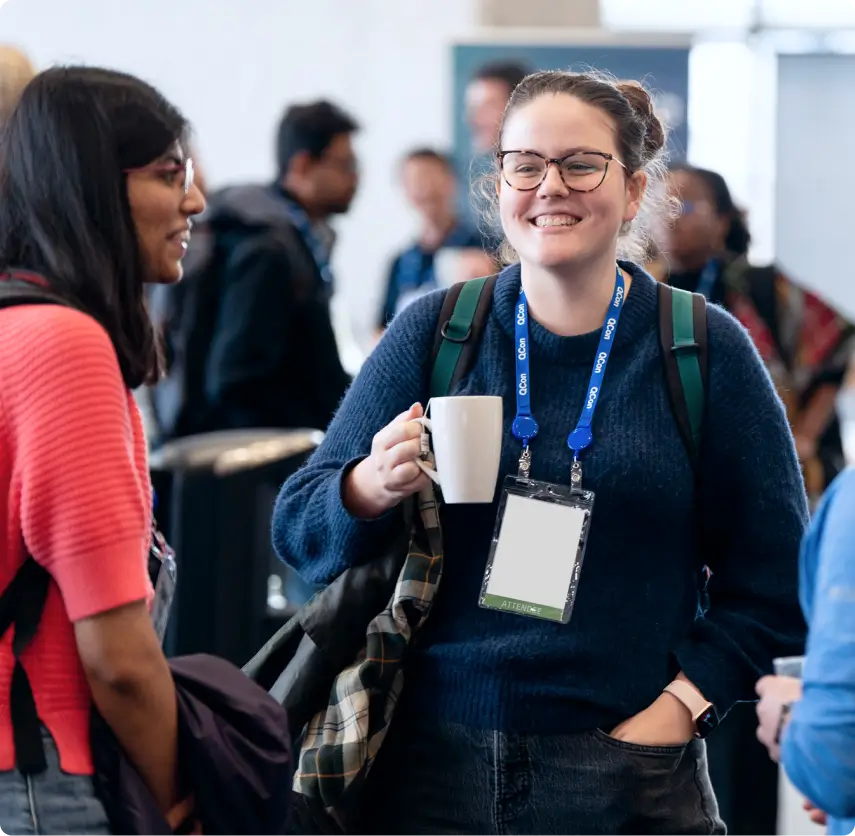
The scheduled sessions at QCon are the agenda, but the real value is in the unscripted moments: the whiteboard debates in an unconference, the candid advice over coffee, the speaker dinner stories about failures and trade-offs. That's the perspective you can't get from a screen.
Principal Solutions Architect, QCon Speaker, O'Reilly Author, YouTuber

QCon is designed for senior practitioners to move ideas forward and solve problems with peers.
Connect with senior developers who understand your challenges. Whether brainstorming new ideas, exploring learning paths, or engaging in casual conversations, our social events and learning spaces are designed for all interaction styles, helping you leave with fresh insights, new connections, and actionable ideas. See all Social Events See all Peer Sharing activities
Convince your manager
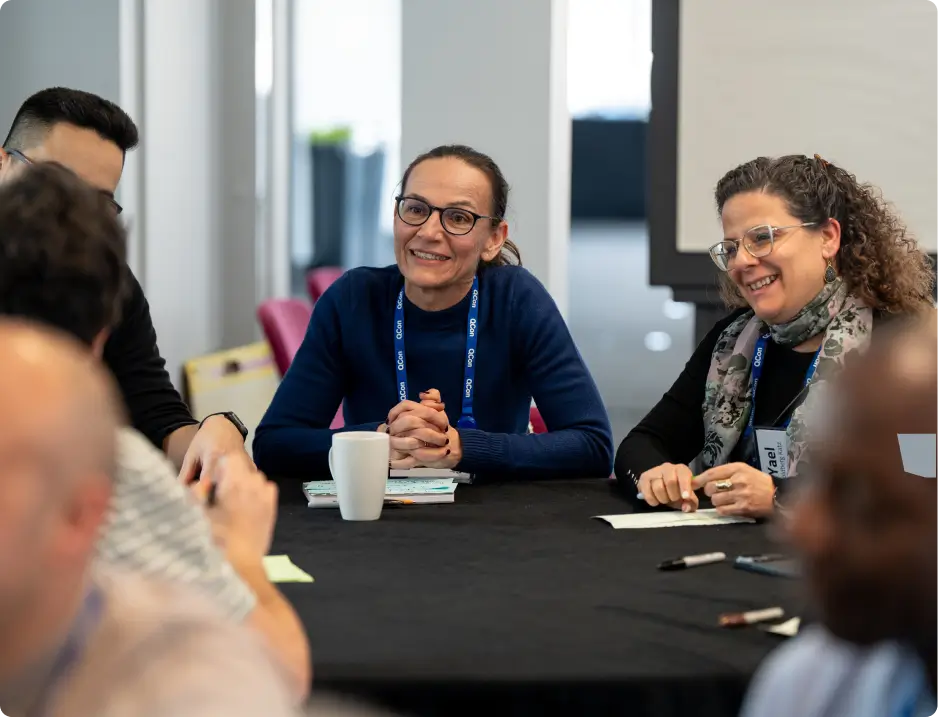
Need to get approval to attend
QCon San Francisco 2026?
We’ve made it easier.
Download a ready-to-use “Convince Your Manager” template, perfect for sharing with your manager.
Get a PDF version of the AI & ML talks at the conference, perfect for sharing with your manager or teammates who want to see what’s covered.
Download the convince your manager template
Get a PDF of the AI & ML talks
Unlock your potential at QCon San Francisco 2026
-
Gain concrete strategies from 60+ hand picked speakers across 12 curated tracks.
-
Real-world talks curated for depth, value, without hidden product pitches.
-
Network with peers at Unconferences, in the 'hallway track', during extended breaks, over lunch, and at conference socials.
-
Gain 12 months on-demand access to session recordings after the conference to continue your learning journey.
We've helped thousands of senior software engineers, software architects and tech leaders adopt the right patterns & practices for over 20 years.


